
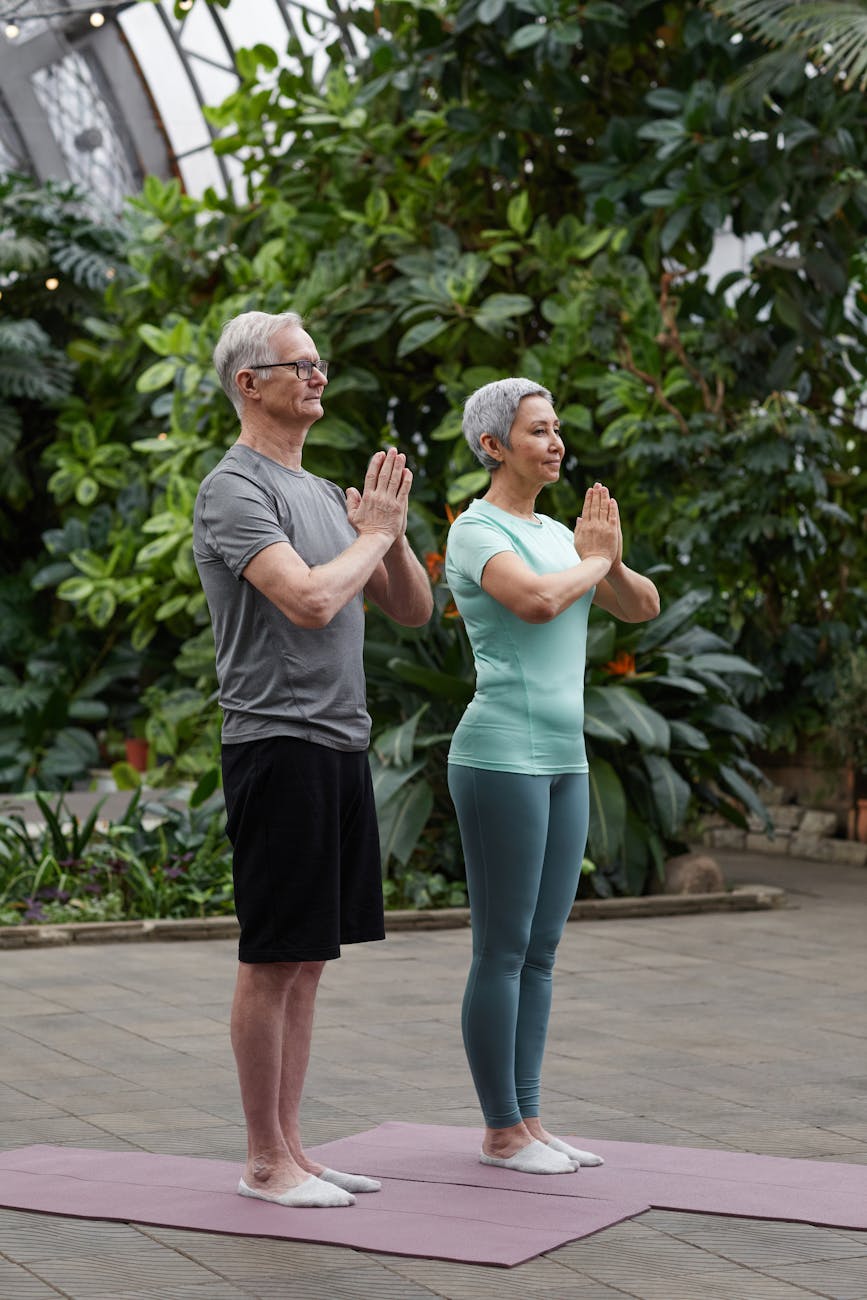
What Is Tadasana?
Tadasana, or the Mountain Pose, is a foundational yoga posture that emphasizes grounding, alignment, and mindfulness. Derived from the Sanskrit words “tada” (mountain) and “asana” (pose), Tadasana symbolizes stability and strength, much like a mountain.
While it might seem simple, this pose serves as the starting point for many other yoga postures and plays a vital role in improving posture, balance, and overall body awareness.

How to Perform Tadasana Step-by-Step
- Start on a flat surface: Stand on a yoga mat placed on an even floor.
- Position your feet: Keep them hip-width apart, with toes pointing straight forward.
- Align your body: Stack your hip bones directly over your ankle bones.
- Shift your weight: Let the weight settle more into your heels rather than your toes.
- Engage your spine: Keep your tailbone neutral—don’t tuck it or overly arch your lower back.
- Relax your shoulders: Gently lower your shoulder blades toward your waist.
- Adjust your gaze: Look straight ahead, keeping your head level and your line of vision parallel to the floor.
Hold this posture for 5 to 7 slow, mindful breaths. Feel the grounding energy flowing from your feet upward, providing stability and focus.
Common Mistakes to Avoid
Even in its simplicity, Tadasana requires mindful alignment to avoid common errors:
- Locking your knees: This can strain your joints and disrupt the flow of energy.
- Flattening the lower back: Maintain its natural curve to avoid discomfort.
- Stiffening the shoulders: Keep them relaxed to promote ease and openness.
- Leaning too far forward: Shift your weight evenly to avoid imbalance.
Paying attention to these details ensures that the posture is both effective and safe.
Benefits of Tadasana
Practicing Tadasana regularly can lead to numerous physical and mental benefits:
- Improves posture: Aligns the body from head to toe, promoting better posture and reducing strain.
- Enhances balance: Develops awareness of weight distribution and stability.
- Boosts mindfulness: Serves as a meditative moment to connect with your breath and body.
- Relieves tension: Encourages relaxation and reduces physical stiffness, particularly in the shoulders and back.
Additionally, Tadasana offers a less formal alternative to seated meditation, making it accessible for individuals who find sitting uncomfortable.
How Long Should You Hold Tadasana?
For beginners, holding Tadasana for 5 to 7 slow, deep breaths is ideal. As you grow more comfortable with the posture, you can increase the duration to deepen your connection and awareness.
Frequently Asked Questions
Can beginners practice Tadasana?
Absolutely! Tadasana is a beginner-friendly pose and serves as a gateway to more complex yoga postures.
What is the best time to practice Tadasana?
Tadasana can be practiced at any time, but it is particularly effective at the beginning of a yoga session or in the morning to set a grounded tone for the day.
How does Tadasana improve posture?
By aligning the spine, hips, and ankles, Tadasana trains the body to maintain proper posture, even outside yoga practice.
Sources and Inspiration
This article was inspired by Judith Lasater’s book Yoga: 30 Essential Poses, which provides detailed guidance on foundational yoga postures.
Leave a Reply